
By James Bohn and Greg Grambow
Wisconsin has spent the past sixteen years building a more competitive business environment. That effort has been successful.
Now, with Democrats firmly in control of state government, David Crowley and legislative leaders are preparing to reverse course. After they take power in January, their top priorities will include repealing every reform of the Walker era.
You don’t need to guess where that will take Wisconsin. We’ve been there before.
Repealing the Walker reforms will put Wisconsin back to where it was in 2010 when the Democrats last had complete control of state government.
Wisconsin in 2010 was not competitive. Its business climate was one of the worst in the nation. A 2010 analysis by Forbes magazine ranked Wisconsin’s overall business climate as the eighth worst in the nation, its regulatory climate as the sixteenth worst, and its long-term growth prospects as the fourth worst.
Wisconsin was one of just 12 states that lost jobs during the 2000s. According to United Van Lines, Wisconsin had the eighth-highest share of outbound-to-inbound moves among all fifty states.
The reforms enacted during the Walker administration changed that. Rather than being viewed as one of the worst states for business, Wisconsin came to be seen as an increasingly attractive place to do business. The turnaround was dramatic.
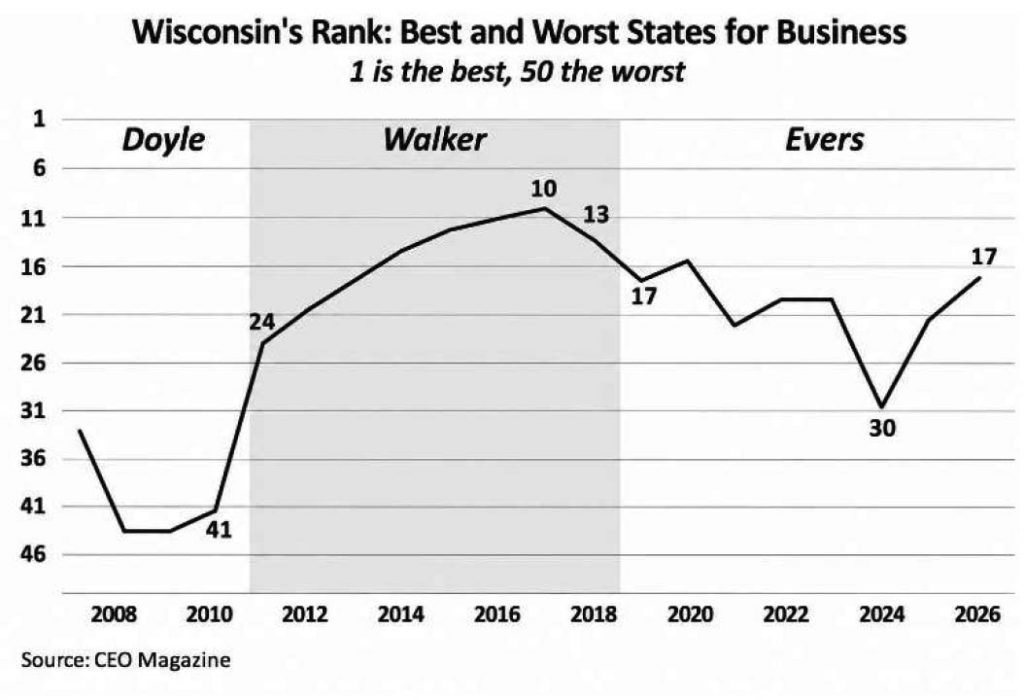
The figure below shows the results of Chief Executive magazine’s annual survey of corporate CEOs over the past twenty years. The magazine asks CEOs to rank each state’s business climate from best to worst. The survey includes corporate leaders from every state.
The views of CEOs are important because CEOs are the ones that make the final decisions about where to invest, expand operations, locate facilities —all decisions that ultimately determine where jobs are created.
Wisconsin was consistently ranked among the worst states in the nation for business during the Doyle Administration. In 2010, CEOs ranked Wisconsin as the tenth worst state for business.
That changed during the Walker Administration. Walker sought to make Wisconsin more competitive by cutting taxes and reducing regulatory burdens.
The state’s best showing was in 2017, when it reached 10th place. In the final year of the Walker Administration, Wisconsin was ranked as the 13th best state in the nation for business.
Wisconsin lost ground over the last eight years under Tony Evers. However, divided control of state government prevented the state’s business climate from deteriorating even further.
So, what do Democrats plan to do in January to undermine free market economics? A few of their stated priorities are listed below.
Repeal Wisconsin’s right-to-work law. This law allows workers to choose whether to join a union. Repealing it will discourage business investment by reducing the flexibility companies have in making decisions on staffing, promotion and production.
Raise income taxes for businesses and individuals. High business tax rates discourage investment. High personal tax rates discourage work and incentivize Wisconsin skilled trades people, business owners, and talented scientists and engineers to flee to low-tax states like Florida, Tennessee, Iowa and Indiana.
Increase Wisconsin’s minimum wage to the highest in the Midwest. Increases in the minimum wage has always meant fewer opportunities for Wisconsin workers, especially for those with fewer skills, younger workers, workers with less experience, and individuals with criminal records.
Wisconsin competes with 49 other states for investment, jobs, and economic opportunity. Its future depends on remaining competitive, not reversing the reforms that helped make the state more attractive to businesses. Unfortunately, Crowley and Democrats in the Senate and Assembly appear determined to return to—and even go beyond—the policies that once made Wisconsin one of the worst states in the nation in which to do business.
Jim Bohn and Greg Grambow are contributors to personaleconomics.org, a website that provides financial and economic education to adults 18 and over.